Showing posts with label Types of Fibers. Show all posts

Wednesday, April 6, 2011

Order Matters!

Doopsy-Bamboo-Hemp-InsertsIf you are using more than one insert in your pocket diapers, it is important to place them in the correct order.  While both of your inserts may have the same fiber composition, you may also benefit from mixing fibers in your inserts.  This is especially beneficial when extra absorbency is needed – for example, naptime, bedtime, and long car rides.  If you are using two different fibers to stuff your pocket diapers, consider carefully the order in which you stack them! 

If one of your inserts is microfiber, you should place that closest to the lining of the diaper.  Microfiber absorbs liquid very quickly, and you want to catch all of the urine as soon as possible.  6r_soaker

Hemp, bamboo, and organic cotton, however, can absorb large amounts of liquid.  Place these inserts or doublers underneath the microfiber insert to hold all of the excess urine.  Though these fibers absorb more slowly, they hold more than microfiber does.

Doable Diapers carries a variety of inserts, liners, and doublers to meet your diapering needs.  Be sure to visit our selection here.  If you have any questions, concerns, or tips, please leave us a comment or send an email to info@doablediapers.com.

Friday, April 1, 2011

A Wool Primer, Part 3

24394_555507097714_55301941_32711496_8358030_nguest post by Marah Mumma

Read the other posts in this series:
Part 1: Facts About Wool, and
Part 2: Types of Wool Products

The Wool Primer #3: Caring for Wool

Wool must be washed and lanolized for proper use. Because of the antibacterial properties of wool, wool covers only have to be washed about once every two weeks, unless they get soiled. Lanolin is the natural waterproofing on sheep's wool. This natural lanolin is what makes the wool "waterproof". The lanolin on the wool cover gets used up by the urine as the cover air dries, so after a while you will need to restore lanolin to the cover to maintain the cover's effectiveness. There are a lot of different wool wash products out there. And there are a lot of different routines for washing. It’s about finding a product and routine that works for you!

Sample Wash Routine:

1. Fill sink with lukewarm water and add wool wash (read bottle for amount to add) or rub with wool bar. If the cover is soiled, rinse first.

Liquid Wool WashLiquid Wool Wash

Liquid wool wash is just that…liquid. Some require rinsing, others don’t. Some contain lanolin, others don’t. Just read the directions on the bottle. Usually manufactures include a suggested wash routine for using their product. Liquids can be scented with either essential oils or fragrance oils.

Examples: Face of the Wave, Eucalan, Lamby Woolwash, Sudz'n Dudz, Imse Vimse wool shampoo, CJ’s.

Wool Wash Bar

Wool Wash BarWool wash bars are essentially a bar of soap that is used for washing wool items. Washing with a bar requires rubbing wool VERY GENTLY with wool wash bar. Wool wash bars can also contain lanolin and scents.

Examples: Face of the Wave, Sudz’n Dudz, Sheepish Grins.

2. "Swoosh" the covers around lightly in the water and let sit for about 10-15 minutes.

3. Rinse. Some washes require a rinse and other do not. Most products will specify if they require a rinse.

4. Refill sink with lukewarm water. Add lanolin. You can either use liquid lanolin or add about a ¼ inch of lanolin (like lansinoh lanolin) to about 2 tablespoons of water in a microwave safe bowl. Heat the bowl in the microwave until the lanolin is dissolved.

5. Put covers in sink and let sit in water/lanolin mixture for 10-15 minutes. Lanolizing (steps 4 and 5) only needs to be done about once a month, not every wash.

6. Remove covers and squeeze out excess water. Roll in a dry fluffy towel. Lay flat to dry.

If you have any questions about wool please feel free to e-mail me, smmumma at gmail dot com and I will do my best to help you out!

Special thanks to Marah Mumma from Diary of a Devil Dog Wife for her expertise, and for taking the time to share it with Doable Diapers readers.  Please stop in at Marah’s blog and tell her we sent you!

Thursday, March 31, 2011

A Wool Primer, Part 2

24394_555507097714_55301941_32711496_8358030_n

guest post by Marah Mumma

Read Part 1: Facts About Wool


The Wool Primer #2: Types of Wool Products

clip_image002There are lots of different types of wool products. Wool products can be used in place of a regular cloth diaper covers over fitted diapers, prefolds, and/or flats.

Wool Cover
Wool covers are very similar to covers made from PUL. They can have snap or Velcro closures. Wool covers come in both sized and one size versions.

Examples: Little Beetles Organic Merino Wool Cover, Little Beetles Little to Big Organic Merino Wool Cover, Imse Vimse Wool Wraps, Swaddlebees Merino Wool Diaper Cover, Baby BeeHinds Wool Wrap Diaper Cover.

Wool Soaker/Pull-On
clip_image003Wool soakers don’t have snaps or Velcro.  Rather, they pull on like a pair of pants or shorts.  Wool soakers are sized.  Soakers can also be hand knit or made from recycling old wool sweaters.

Examples: Disana Organic Merino Wool Pull-On, Kissas Wool Lovers wool diaper cover, LANAcare Merino Wool Pull-On, Kissaluvs Wool Diaper Cover, Tiny Tush Wool Soaker Diaper Cover, Sustainablebabyish knit wool covers.

Wool Longies

clip_image004Just like wool soakers, wool longies don’t have snaps or Velcro. They are just like a pair of pants, but made from wool. Wool longies are sized and some come in different lengths. Longies can also be hand knit or made from recycling old wool sweaters.

Examples: Sustainablebabyish Knit Wool Longies, Little Beetles Organic Merino Wool Pants, Disana Merino Wool Leggings, LANAcare Merino Wool Pants.

Stay tuned for Part 3 – Caring for Wool!

Wednesday, March 30, 2011

A Wool Primer, Part 1

24394_555507097714_55301941_32711496_8358030_nguest post by Marah Mumma

I asked Marah from Diary of a Devil Dog Wife to write a guest post on the basics of using wool in cloth diapering.  Marah has become one of my “blogging friends” – though we have never met, I feel as if I know her like a good friend.  She knows a lot about using wool products.  Marah went above and beyond what I asked for, and provided a mini-series on wool products.  Today we have part 1.  Be sure to come back for parts 2 and 3 later this week! 

The Wool Primer #1: Facts About Wool

Hello, Doable Diaper fans! My name is Marah and I blog over at Diary of a Devil Dog Wife. I am a stay at home mom to my 16 month old son, Kolt, full time college student, and wife to a talented Sergeant in the Marine Corps.

I was SO excited when Andrea asked me to write a series of guest posts about wool and cloth diapering! I first came across wool when I was searching for an overnight cloth diaper solution. I found many suggestions about using wool overnight. WHAT!?!? WOOL?!?! I was scared and intimidated. I wanted desperately to find an overnight solution, but wool?!?! Wasn't that only for cloth diapering experts? What about washing and lanolizing? I was worried I wouldn't be able to handle it or figure it out.

But let me tell you, it's EASY! I started out just using wool at night, but I now use it during the daytime, especially when Kolt is battling a rash. And I certainly plan on using wool this summer during the hot and humid days in North Carolina. I hope that through this wool primer, you will see the benefits of wool, the simplicity of using it, and venture out to try it yourself!

Wool fact #1

Wool has a built in climate control. It is a natural insulator to keep you warm in the winter and naturally breathable to keep you cool in the summer. Wool helps to keep you body in the optimal temperature zone for comfort and rest!

Wool fact #2 

Wool fiber is a naturally absorbent fiber and the original wicking fiber. Its coil-like shape pulls excess heat and moisture from your skin while you sleep. Wool fabrics can absorb up to 30% of their weight without feeling heavy or damp. Cotton fabrics begin to feel damp after 15%. The absorbent fibers "breathe" by wicking away moisture from the body and releasing it into the air. This is why wool can be used as a cover over prefolds and fitted cloth diapers.

Wool fact #3

Wool is naturally mildew and mold resistance. Wool's natural resistance to mildews and molds comes from the way it repels moisture, and lets moisture pass through its fibers without holding the moisture. Mildews and molds require moisture to live and grow. This means that wool covers only have to be washed about every two weeks or so, unless they get soiled!

Wool fact #4

Wool is durable. Laboratory tests have shown that wool fibers resist tearing and can bend back on themselves more than 20,000 times without breaking. Cotton breaks after 3,200 bends, silk fibers break after 1,800 bends, and rayon fibers break after just 75 bends. Wool clothing will last for years. Wool resists spills, dries very quickly and is mildew resistant. Therefore, you can rest assured that your investments in wool will last.

Wool fact #5

Wool is almost entirely non-allergenic. Although some people do have a rare natural allergy to Lanolin, the oil found in wool, most people's allergy to wool is a reaction to the many harsh and toxic chemicals that go into the treatment, and finishing of conventional wool garments and bedding. This makes wool a great alternative for those who are allergic to PUL, the water-proofing fabric found in most pocket diapers, all-in-one diapers, and covers.

Wool fact # 6

Wool is renewable and sustainable. Wool is a renewable resource that can be shorn from sheep annually. It is biodegradable and kinder to the environment than oil-based synthetics, which contribute to global pollution. Wool is sustainable. Wool from free-grazing sheep, treated ethically throughout their long lives, represents a traditional small-scale industry that once thrived in America. Today, many small organic farmers are returning to this sustainable industry to create clean and healthy wool that is produced without stress to the animals or the environment.

Wool fact #7

Wool fabric doesn't collect much static because of its absorbent fibers. Static attracts lint, dirt, and dust. Wool fabrics also clean easily because dirt sits on the surface of the fiber. The outside surface of the wool fiber consists of a series of overlapping scales, similar to the feathers on a bird, making it easy to brush off and for stains to lift out.

Check back tomorrow for Part 2 of the Wool Primer – Types of Wool Products!

Tuesday, January 4, 2011

A Cloth Diaper Primer, part 3

This series is intended to simplify the vast amount of information available on cloth diapers.  Cloth diapering “newbies” may be overwhelmed at first, but cloth diapers really are easy!  Did you miss the other posts in this series?  Read part one here.  Read part two here.

Fabric Options

The options seem unlimited in this category of cloth diapering.  It may seem complicated and overwhelming, but it doesn’t have to be!  I am by no means a textile expert, but I do know a little bit about cloth diapers!

FBMedLargeInserts3Pack-120Microfiber:  This seems to be the first choice in many diapers.  Microfiber is a synthetic blend.  It is highly absorbent, and it absorbs very quickly.  Many diapers, such as FuzziBunz, Rumparooz, and bumGenius come with a microfiber insert.  Microfiber is usually used as an insert, and does not come into direct contact with the baby’s skin.

Pros:  Very absorbent, and can also be very trim.  Dries quickly.

Cons:  Because of the “micro” part of the fiber, stink and residue can become easily trapped.  There is a process called stripping that removes this residue and build-up and returns to microfiber to its original condition.  I have found that HE washers and hard water are the primary culprits for causing microfiber to have buildup, but your laundry detergent can also cause problems.  (Don’t worry about it until it happens…I have only stripped my diapers once in over a year.  Read more about stripping here.)

Examples:  Fuzzibunz, Rumparooz, and bumGenius! all come with microfiber inserts.

Cotton: We are all very familiar with cotton!  It is breathable, absorbent, and easy to care for.  The most widely used cotton diapers are pre-folds.  Cotton is a natural fiber.  Some WAHM diapers use recycled t-shirts as the soaker – these are cotton also.

Pros: Cotton is highly absorbent and easy to care for.

Cons: It is not stay-dry, so you may want to use a liner if you choose cotton diapers.  However, cotton is a natural fiber, so it is still soft on baby’s skin.

Examples:  Prefold diapers

Organic Cotton:  Some people prefer that only organic fibers lay against their baby’s skin.  Organic cotton has been grown without pesticides.  It is usually super soft and super absorbent.

Pros:  Organic fabric, natural fiber.  It is soft and absorbent.  Though it is not stay-dry, you don’t need a liner. 

Cons:  The organic products that I have used require a longer drying time.  To get an organic product you must pay a higher price.

Examples:  Flip organic inserts; bumGenius Elemental diapers.

Bamboo:  Bamboo is an excellent choice for cloth diapers, and “going green.”  It is a sustainable fiber source – bamboo grows quickly and requires little irrigation, making it easily renewable.  The fibers are made from the extracted pulp of the bamboo plant.  Bamboo is up to 60% more absorbent than cotton, and it is luxuriously soft.
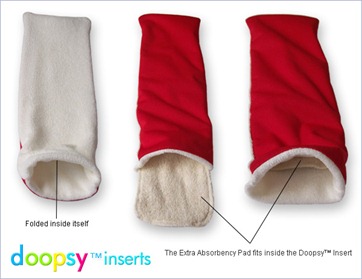
doopsy-inserts-graphicThe Doopsy insert is a bamboo blend with a bamboo hemp booster.

Pros:  Softness, absorbency.  Bamboo is an excellent choice for heavy wetters or night time use.

Cons:  Usually bamboo is a fitted diaper or insert, so you will likely need a diaper cover or pocket diaper to stuff it in.  Bamboo can be a little more pricey

Example:  Doopsy diapers with SD insert.

Hemp:  Hemp fibers are strong and grow quickly. They are usually very coarse, but processing methods allow it to be softened into a wearable fabric. There are several characteristics of hemp – it is strong, durable, and absorbent.  Hemp requires no pesticides to farm and it doesn't deplete soil like cotton.  It also has natural anti-microbial properties, which may aid in deterring mold, bacteria, and fungus.

Pros: Hemp is very absorbent, just like bamboo.  Sometimes hemp is blended with organic cotton or bamboo for even more absorbency.  These blends are a little softer.

Cons:  Hemp is very rough, even when it is softened.  I don’t like to put hemp next to my baby’s skin, so I don’t like hemp prefolds.  However, a hemp insert or booster is an excellent choice!

Examples:  FuzziBunz Hemp Diaper; Rumparooz diapers can be upgraded to a hemp insert.

Polar Fleece, Micro-Fleece or Micro-Suede:  These fabrics are usually used as the lining in a pocket diaper.  They wick moisture. These fabrics are not only soft when placed next to the baby’s skin, but they move the moisture quickly into the soaker or insert beneath.  This keeps baby dry and happy.

Pros:  Baby stays dry and rash is kept at bay.  Soft against baby’s skin.  Micro-suede seems easier to spray poo off of rather than fleece.  Quick drying!

Cons:  Fleece may pill slightly but it doesn’t affect performance.

Wool: Wool diaper covers are a great option for several reasons.  Wool is soft, absorbent, and naturally anti-fungal.  It is also highly breathable.  If your baby is prone to diaper rash, or just has a bad rash, wool is a good option.  It allows the baby’s skin to breathe while still providing a waterproof outer layer.  Wool also absorbs any excess moisture from the diaper.  Wool covers may sometimes be referred to as shorties (they look like shorts) or longies (they look like pants).

Pros:  Wool doesn’t have to be washed as often because of its high absorbency.  It is soft and breathable.  It is a natural fiber.

Cons:  Wool does to be lanolized sometimes in order to help maintain waterproof properties.  This is an extra step.  It can be more expensive to purchase.

{Read Part 1}
{Read Part 2}

Related Posts Plugin for WordPress, Blogger...